
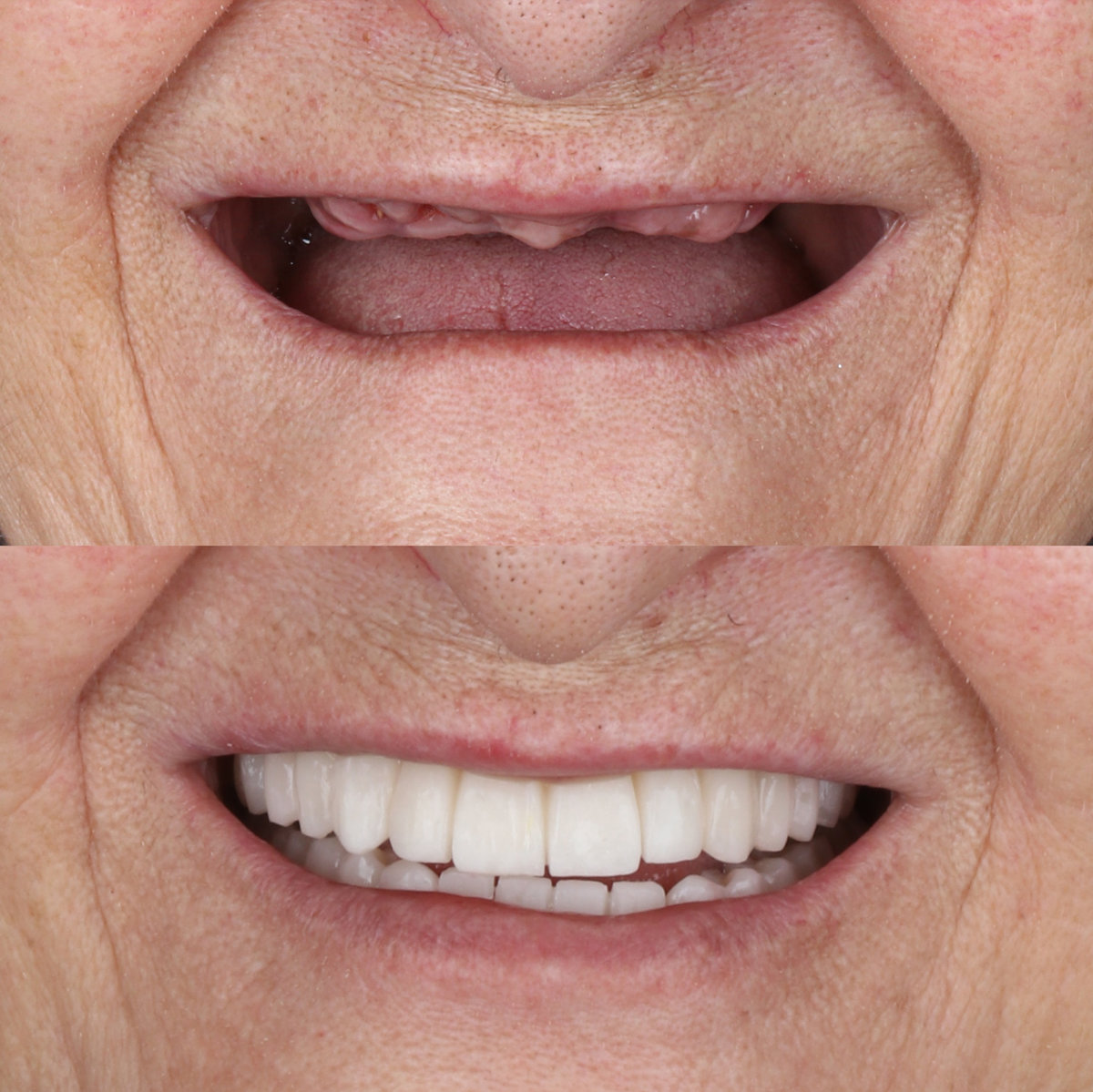
When you are facing complete tooth loss, traditional dentures and full-arch dental implants represent two very different paths to a restored smile. Traditional dentures are removable prosthetics that rest on your gums and depend on suction or adhesive to stay in place, while full-arch dental implants use four or more titanium posts anchored in your jawbone to support a fixed set of teeth that never comes out. The right choice for you depends on your oral health, your budget, and how you want your daily routine to look.
At Ponce Dental Studio, we help Georgia patients weigh both approaches with complete transparency. Whether you currently wear removable dentures and want to explore a permanent alternative, or you are comparing options for the first time, our doctors use digital impressions and treatment-planning technology to match you with a solution suited to your oral health, lifestyle, and budget.
How Do Traditional Dentures Work?
Traditional dentures are removable prosthetics that rest on your gums to replace some or all of your missing teeth. A complete upper denture covers the roof of your mouth for added suction and stability, while a complete lower denture rests on the gum ridge and typically relies more on the surrounding muscles and tongue to stay in place. Partial dentures use metal or acrylic clasps that attach to your remaining natural teeth.
Most denture wearers remove their appliance nightly for cleaning and to give their gums a rest, then reinsert it each morning, sometimes with an adhesive for extra hold. This approach has helped people eat and speak for generations, and modern denture materials and fabrication methods have improved comfort and fit compared to earlier designs. Even so, dentures rest on soft tissue rather than a fixed anchor, so some slipping during meals or conversation is common, and periodic relining or adjustment is often needed as your gum ridge and jawbone change shape over time.
What Makes Full-Arch Dental Implants Different?
Full-arch dental implants take a different approach by anchoring a complete, fixed set of teeth to four or more titanium posts surgically placed in your jawbone. Over several months, the titanium fuses with the surrounding bone through a process called osseointegration, creating a stable foundation that functions similarly to natural tooth roots. Once healed, the custom prosthesis attaches securely to the posts and stays in your mouth full time.
Because the implant posts transmit chewing forces into the jawbone the same way natural tooth roots do, full-arch implants can help support bone structure rather than simply resting on top of it. You care for full-arch implants largely the way you care for natural teeth, using daily brushing and flossing along with routine professional cleanings, rather than removing and soaking a removable appliance.
Can You Eat Normally With Each Option?
Traditional dentures reduce biting force compared to natural teeth, and slipping during meals can make sticky foods, raw vegetables, and chewy meats more difficult to manage. Many denture wearers adjust their diets over time, cutting food into smaller pieces or avoiding certain textures altogether to prevent discomfort or embarrassment.
Full-arch implants restore approximately 70 to 80 percent of natural biting force, according to research from the National Institutes of Health. Because the prosthesis is fixed rather than resting on the gums, patients generally report more confidence eating a wider variety of foods without the movement or slipping associated with removable dentures. Neither restoration removes every dietary consideration, but the fixed nature of full-arch implants tends to support a broader range of foods over the long term.
How Does Each Option Affect Your Jawbone and Facial Structure?
One significant difference between traditional dentures and full-arch dental implants involves what happens to the bone underneath. When teeth are missing, the jawbone no longer receives the stimulation it needs from chewing, and it gradually begins to resorb. Traditional dentures rest on top of the gums and do not transmit that stimulation, so bone loss generally continues at a pace similar to having no restoration at all.
Over time, this resorption can change the shape of the lower face, contribute to a sunken appearance, and require increasingly frequent denture adjustments or replacements to maintain a proper fit. Full-arch implants work differently because the titanium posts transfer chewing forces directly into the jawbone, similar to natural tooth roots, which helps support existing bone density. You can read more about why jawbone preservation matters for your long-term oral health and facial structure.
How Do the Two Options Compare for Everyday Life and Speaking?
Beyond function and bone health, traditional dentures and full-arch implants also differ in how they fit into daily life. Removable dentures require a nightly routine of taking the appliance out, cleaning it separately from your natural gums, and storing it properly so it does not dry out or warp. Some wearers also keep adhesive on hand throughout the day for extra security during long meetings, exercise, or social events.
Speech can take some adjustment with either option while your mouth gets used to its new shape, though a poorly fitting or shifting denture can make certain sounds harder to pronounce consistently. Because full-arch implants are fixed in place and do not rely on suction or adhesive, many patients find speech stabilizes more predictably once the prosthesis is placed. For patients balancing work, travel, and social commitments, the difference between a removable appliance and a fixed one is often as much about daily convenience as it is about the mouth itself.
What Factors Influence Candidacy for Each Option?
Candidacy for full-arch dental implants depends on a combination of factors, including the amount and density of jawbone available to support the titanium posts, the health of the surrounding gum tissue, and general health considerations that can affect healing. Patients who have experienced significant bone loss may still be candidates after bone grafting for implants restores adequate volume, while others may be better suited to a different approach.
A few general factors that commonly come up during a candidacy evaluation include the following.
- Bone volume and density in the areas where implants would be placed
- Gum tissue health and any history of periodontal concerns
- Overall health factors that can influence healing after oral surgery
- Personal preference regarding a removable versus a fixed daily routine
Not every patient who wants full-arch implants is a candidate right away, and some may benefit from implant-supported dentures as a middle-ground option that combines some of the stability of implants with a removable design. If you are missing only some of your teeth rather than a full arch, reviewing how to choose between partial dentures and dental implants may be a more directly relevant starting point than comparing full-arch options. A thorough evaluation, including imaging and a review of your oral health history, is the only reliable way to determine which option fits your situation.
Which Option Requires More Maintenance and Long-Term Care?
Traditional dentures demand a consistent daily routine of removal, cleaning with a non-abrasive denture solution, and overnight storage in water or a soaking solution to prevent warping. Many wearers also rely on adhesive for a secure fit and need regular dental visits so their dentist can check the fit as their gum ridge changes shape. Most traditional dentures need to be relined, adjusted, or replaced within roughly five to seven years.
Full-arch implants simplify daily maintenance considerably. You brush and floss around the fixed prosthesis much as you would natural teeth, and you attend routine checkups so your dental team can monitor the implants, the gum tissue, and the prosthesis itself. With consistent oral hygiene and regular professional care, implant-supported teeth are designed to last for many years, which shifts the maintenance burden away from daily removal and toward routine preventive care.
What’s the Cost Difference Between Traditional Dentures and Full-Arch Implants?
Traditional dentures typically involve a lower cost at the time of treatment, but ongoing expenses add up over the years, including adhesives, cleaning supplies, periodic relining, and eventual replacement. Patients sometimes underestimate how much these recurring costs accumulate over the life of the appliance.
Full-arch dental implants generally require a higher upfront investment because the treatment involves surgical placement of the implant posts along with the custom prosthesis. Because the result is designed to last for many years with proper care, the ongoing costs are typically lower than what a denture wearer spends over time on adhesives, adjustments, and replacements. We offer transparent pricing at Ponce Dental Studio and work with Delta Dental, Principal, and Ameritas to help you maximize your insurance benefits, and our team can also walk you through financing options so a permanent solution fits within your budget.
Schedule Your Consultation at Ponce Dental Studio
Traditional dentures and full-arch dental implants each serve different needs, budgets, and lifestyles. Traditional dentures remain an accessible, removable option for replacing missing teeth, while full-arch implants provide a fixed, long-term solution that supports chewing function and jawbone health. The right choice depends on your oral health, your daily routine, and what matters most to you in the long run.
Ready to find out which option fits your smile and your goals? Complete our contact form to schedule a consultation at either our Atlanta or Buckhead location. Our doctors will evaluate your oral health, discuss your goals, and outline a personalized treatment plan, and you can also visit our YouTube channel to see more about our approach to dentistry.
Frequently Asked Questions About Dentures vs. Full-Arch Dental Implants
Is bone grafting always necessary before full-arch dental implants?
Not always. Whether bone grafting is needed depends on how much healthy bone remains in your jaw and how it is distributed. Some full-arch systems are designed to work with the bone naturally available in certain areas of the jaw, while others require added bone volume first. A dental evaluation with imaging is the only way to determine whether grafting applies to your situation.
How long does recovery typically take after full-arch implant placement?
Initial healing after surgical placement generally takes several days to a couple of weeks before most patients feel comfortable resuming normal activities, though the full osseointegration process where the implants fuse with the jawbone can take a few months. Your dental team will provide a timeline based on your specific treatment plan and healing progress.
Can traditional dentures be replaced with full-arch implants later on?
In many cases, yes. Patients who currently wear traditional dentures can be evaluated for full-arch implants at any point, though the amount of jawbone that remains after years of denture wear can affect the treatment plan. A consultation that includes imaging will show whether you are a candidate as is or whether additional preparation, such as bone grafting, would be recommended first.
Do full-arch dental implants ever need to be replaced?
The titanium implant posts are designed to remain in place for many years with proper care, while the visible prosthesis on top may eventually need adjustment, relining, or replacement due to normal wear. Routine checkups allow your dental team to monitor both the implants and the prosthesis so any maintenance can be addressed early.
Are full-arch implants noticeably more expensive than traditional dentures upfront?
Yes, full-arch implants generally involve a higher upfront cost because the treatment includes surgical placement of the implant posts in addition to the custom prosthesis. Traditional dentures cost less initially, but ongoing expenses for adhesives, cleaning supplies, and periodic replacement can add up considerably over time.
 Dr. Frank Nia is a distinguished cosmetic and restorative dentist, co-founder of Ponce Dental Studio in Atlanta, GA. With a DMD from the University of Pennsylvania School of Dental Medicine and an MSEd in Higher Education, Dr. Nia brings over a decade of experience in managing multi-site dental practices. Known for his innovative approach to dentistry, he combines cutting-edge technology with compassionate care. Dr. Nia is a Fellow of the International Congress of Oral Implantologists and holds licenses in multiple states, including certification for oral and I.V. Sedation therapy in Georgia.